
Koa Peat Scouting Report


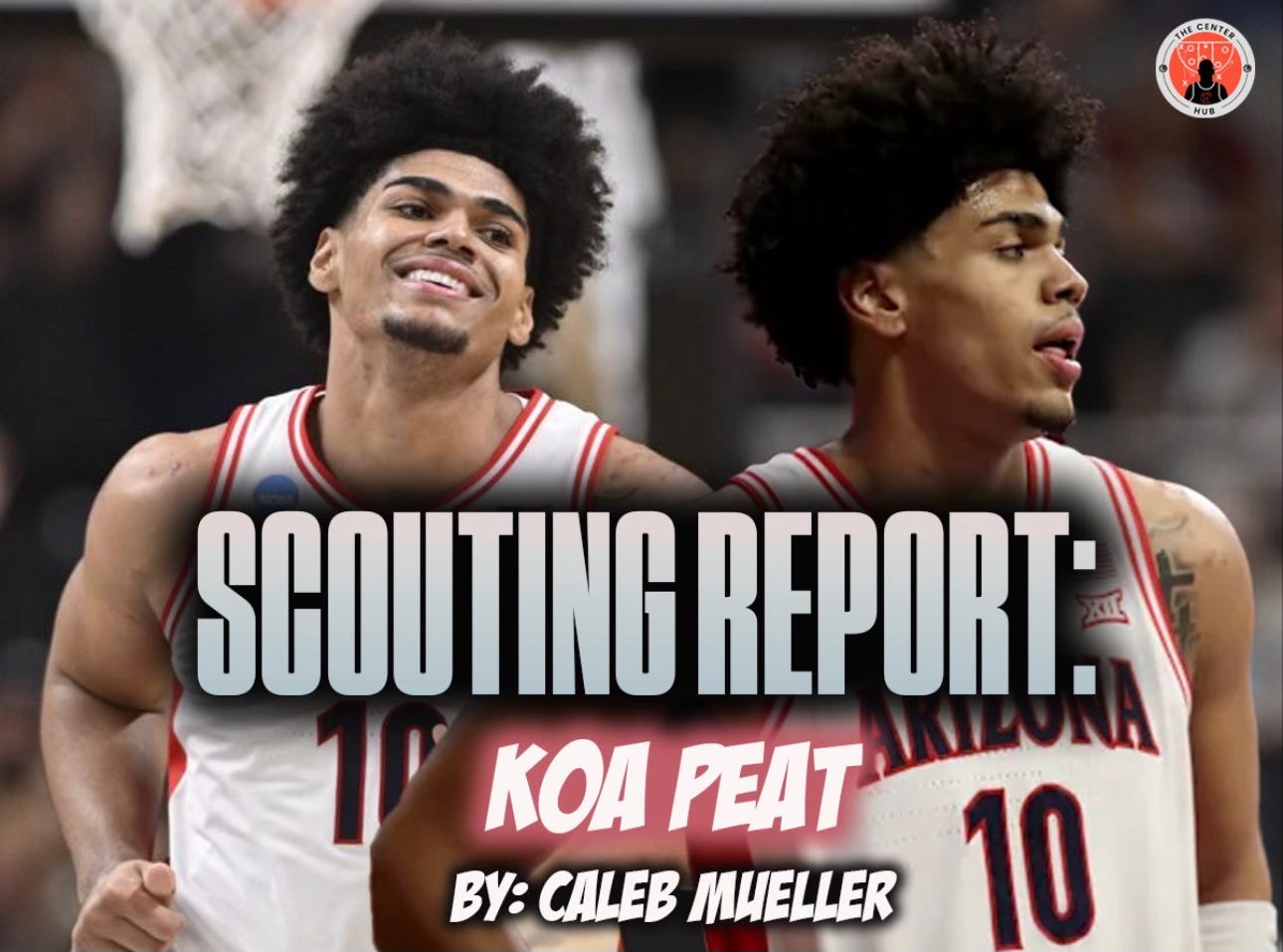
Often, prospects can be overshadowed by one key moment that sticks in scouts, fans & evaluators’ minds. I think we will look back at where Koa Peat goes in this year’s draft & see that he fell victim to what many scouts and evaluators call recency bias. While other basketball minds may disagree with this argument in the context of Peat, I find it very prevalent. Before March, Peat was a bona fide lottery prospect & was gaining traction as a top 10 pick candidate due to his versatility, physicality & athleticism on display during his freshman year at Arizona. His ability to fit into a multitude of roles seamlessly & help create winning moments for Tommy Lloyd allowed him to display his strengths throughout the season in a significant role.
However, when we look at Peat’s stock now, I am looking for where the time went. I watched the Arizona vs Michigan Final Four game live and saw him brick layup after floater after layup. To someone who only watched the tournament, I can understand the placement, 6 for 18 in a huge game? Not ideal. But, when looking back at his basketball career at large so far, I don’t know why we as evaluators place such a large emphasis on one game. At least in this case. Peat was a dominant force throughout his high school development & was even the 2nd most efficient player on a USA U17 team with Cam Boozer & AJ Dybansta. He was second on the team in rebounding and in a dominant team USA run looked like he was one of the best young prospects in basketball, not just another guy.
With this context in mind, I try to approach Peat with the perspective that I am seeking to bring in players who will be elite at what they are good/great at currently. I find that too many evaluations hang on a shooting leap or a mindset change, when in reality, players struggle to achieve these aspirations more often than not. Peat is a quality rebounder and an impact defender. He makes the right play more often than not with the ball in his hands & while he had a poor game against a dominant Michigan team, he shot 66.8% at the rim last year. Knowing he can do these things, I find it hard to get hung up on a lack of a jump shot. He still shot 7 for 19 on catch & shoot threes for the Wildcats, including 5 for 8 when unguarded. He shot 62.1% at the line, not a good number, but he was able to get the line a good amount due to his ability to finish through contact & get to the rim with a dribble or quick cut from the dunker spot or the corners. I look around the NBA, and I see plenty of players who fit this mold as prospects & turned out to be very good NBA players, regardless if the three-ball comes around.
Defensively, Peat was a pillar of Arizona’s success; his seamless fit alongside Bradley & Krivas was clear & led the way for him to start all 36 games at AZ. He was a very good isolation stopper & demonstrated his ability to make plays rotating from the weakside. His stock numbers are great, but I really love Koa’s profile as a defender. He can guard most players regardless of position due to his immense strength for a teenager & because of that, I like him as a fit with most teams in this draft. It’s not hard to see how Carter Bryant was able to get minutes for the Spurs, while being more perimeter oriented & quicker. In this era, you need guys who can get stops. Koa can do that, so much so that in isolation possessions where Koa was the primary defender to start & finish the play, his opponents shot 6 for 29. At the rim, opponents shot 20 for 50 when he was around to contest & challenge. Both metrics, although not perfect due to the nature of Synergy Sports’ complex database & player tracking, represent the type of player you can find with Peat.
Overall, Koa’s strengths outweigh his perceived weaknesses. He did not have a phenomenal year at Arizona, but he was able to create enough dynamic plays on both ends that helped propel them to the Final Four. To me, this warrants a lottery pick alone, when you consider his pedigree as a top recruit & motor on the defensive end. While his jumpshot & overall scoring efficiency outside of rim touches were a struggle, only generating 1.07 points per field goal attempt, I think you have to look beyond a player’s flaws when their strengths are rooted in how they play the game anyway. There are a lot of coaches in the NBA that would love to get their hands on a player like this, 6’8” wide frame & tons of upside to develop into a possible two-way star or even just a dynamic role player. The best part, they don’t have to teach him how to make the right plays that lead to winning.
 |
|