
Jamar Brown Scouting Report


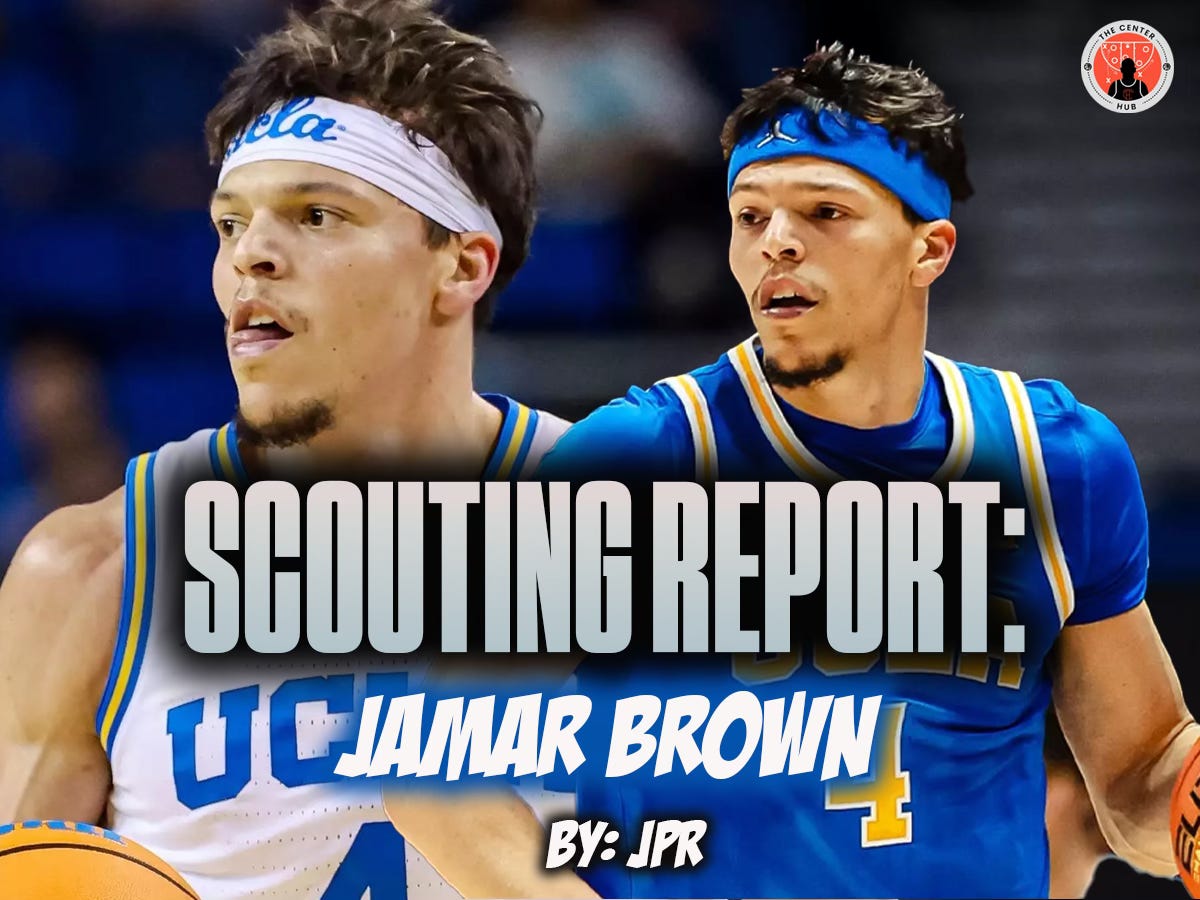
Jamar Brown is a guy I really hope gets a chance at summer league, and he has already had a few NBA workouts so far. He was excellent in the Summit League for Kansas City and played his fifth and final collegiate season at UCLA. At UCLA his role scaled down dramatically but the winning impact stayed real even when the counting stats did not jump off the page.
Strengths
The rebounding is the headline trait. At UCLA this past season Brown finished in the 93rd percentile in offensive rebound rate, which is an exceptional number for a guard listed at 6’5. He is one of the best players in this entire draft class at generating extra possessions for his team, and that skill does not disappear just because the role around him changes. It is a translatable, year over year trait that shows up regardless of usage.
The shooting profile is legit too. At Kansas City as a senior he shot 45.3/40.1/89.9 while averaging 7.4 rebounds a game, and across his final three collegiate seasons combined he shot 45.0% from the field, 36.3% from three, and 88.6% from the free throw line. Those are translatable shooting indicators for a low usage guard whose job at the next level would be to space the floor and make the right read rather than create his own offense. He earned first team All-Summit League honors and was the Summit League Newcomer of the Year during his breakout junior season at UMKC, a year where he averaged 15.0 points and 6.1 rebounds a game on 45.4% shooting.
He is a smart player who makes good cuts and timely passes. He has the kind of off-ball movement that keeps possessions alive even when he is not the focal point. That feel is part of why his role compressed so cleanly at UCLA without him becoming a negative on the floor.
The defensive advanced numbers tell an interesting story too. Brown finished in the 91st percentile in DRAPM at UCLA this past season after being a clear negative defender at Kansas City. I think that shift is largely explained by role scalability. Asked to defend a smaller slice of possessions, and operate within a deeper, more talented UCLA roster, his defensive impact metrics looked completely different than they did when he was the focal point of the Kansas City offense.
Weaknesses
The production at the high major level just was not there statistically. In 36 games at UCLA, Brown averaged only 3.8 points and 2.7 rebounds in roughly 15.6 minutes a game, a steep drop from the 16.0 points and 6.7 rebounds he averaged across two seasons at Kansas City. Even within that UCLA season the role faded further as the year went on. Over the first 13 games he was playing 20 minutes a night and shooting 15 for 33 from three, then lost his rotation spot once Big Ten play started and was down to 7.8 minutes a game by the final month, shooting just 10 for 40 from deep over that stretch. That is a significant swing within a single season, and it raises a fair question about consistency and how a role that thin in college basketball could possible garner a spot in the NBA.
The counting stats concern is really the central issue for how front offices will view him. He plays winning basketball and impacts winning in ways that show up in the advanced numbers. Despite that, I am just not sure an organization will value that toolset enough on its own to extend an Exhibit 10.
That is exactly why summer league matters so much here. If he gets an invite, I think he can really make a mark in the fourth and fifth games of summer league, the games when the top draft guys are resting. His shotmaking and his knack for generating extra possessions on the glass are the kind of traits that can spark real interest from front offices in that setting, even if the box score from his final college season does not show it. I could honestly see him drawing interest from an organization like Toronto, who have recently shown they value exactly this kind of player: good shooters who make the right play and consistently find a way to create extra possessions for their team.