
Ebuka Okorie Scouting Report
The preseason's most surprising draft prospect broke out in a major way at Stanford. Now, he's a one and done.


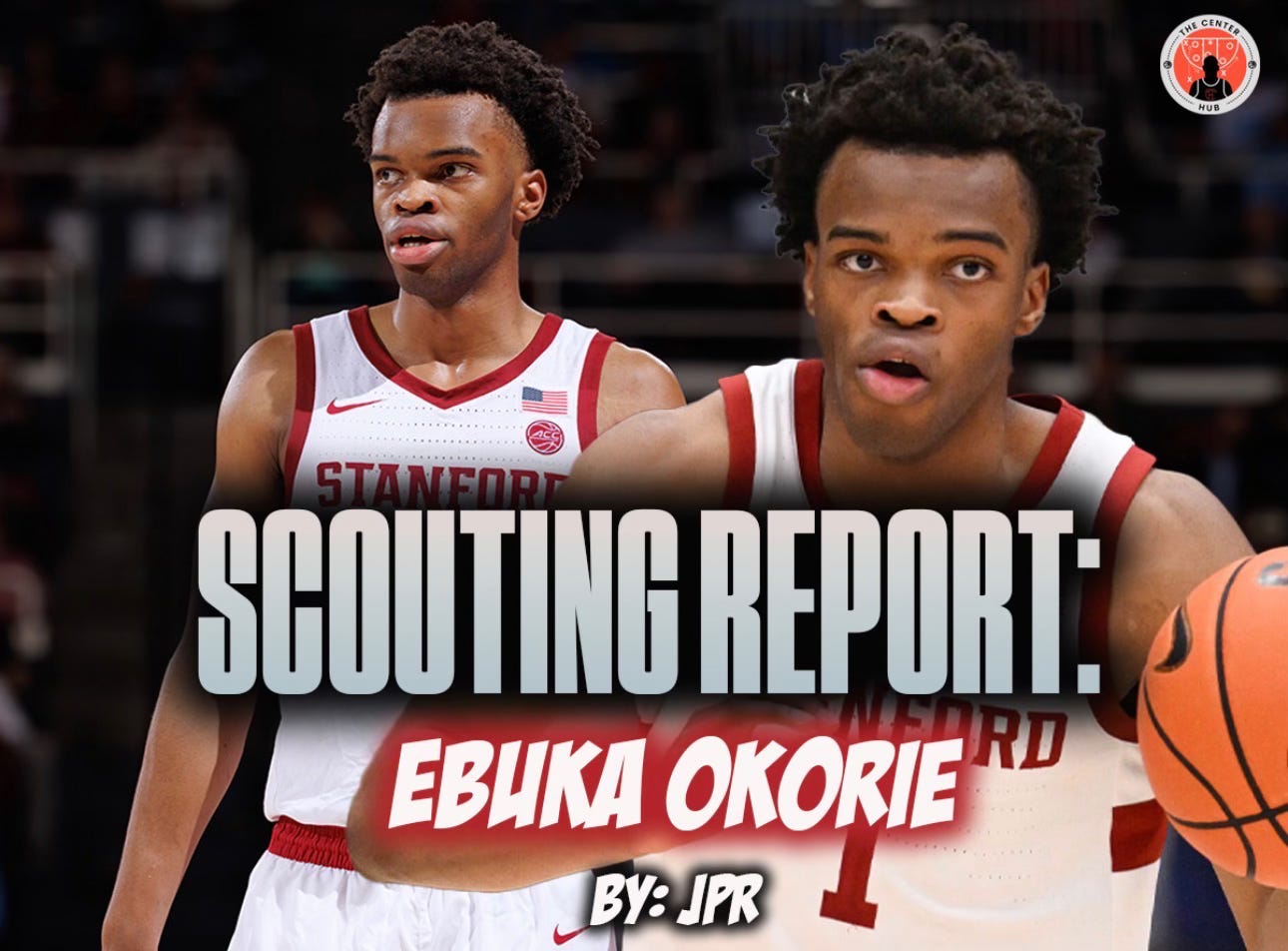
Ebuka Okorie might be the most surprising prospect in this class relative to preseason expectations. Coming out of Brewster Academy alongside Dwayne Aristide, Sebastian Wilkins, and Killiyan Toure, Okorie looked on paper like he might be the fourth best pro prospect out of that group heading into the year. He ended up being the best one. A year at Stanford where he had the full keys of the offense changed the conversation entirely, and he sits comfortably in my 11 to 20 range as a result. The profile is not without questions, but the offensive ability is real and it showed up consistently in a high level environment.
Strengths
The most important thing Okorie showed this year is that he can handle being the guy. At Brewster he was more of a distributor and facilitating within a loaded roster. Stanford asked him to do something different, to be the primary creator and initiator at every level of the offense, and he delivered. That kind of role expansion in one year is not something every prospect can absorb, and the fact that he not only handled it but dominated says something real about his processing and confidence with the ball in his hands.
He is a genuine shot creator off the bounce. You cannot have enough of those in the NBA and Okorie has that skill in a way that projects. He gets downhill, forces help, and when defenses collapse he finds his teammates. A 23.9 assist rate is big time and he generated a significant number of open looks for his teammates this season, which is the kind of secondary creation value that translates directly to winning basketball at the next level. The playoffs this past year made it crystal clear how important it is to have guards who can genuinely handle and create in late game situations, and Okorie has that in his toolkit.
The frame is another underrated part of the profile. At around 6’2” and 190 pounds with a 6’8” wingspan, the physical tools are better than the height number suggests. The wingspan changes the equation on both ends. He has a strong build and the frame to hold up against NBA physicality without being pushed off his spots. The fact that he did not foul much at Stanford is a meaningful indicator as well. Guards who struggle with length and strength tend to reach and foul.
Weaknesses
The 59% rim finishing rate is the one offensive number that gives me pause. For a guard who gets to the paint as frequently as Okorie does and who carries the offensive load the way he did at Stanford, that number needs to be a bit better. NBA length and athleticism at the rim is a different animal. The creative ability off the bounce will keep him getting to the paint regardless, but the finishing efficiency has to improve for the full offensive profile to really jump.
Defensively, the profile is going to be one dimensional and that is just the honest reality. The wingspan helps and gives him a chance to be a disruptive presence in passing lanes, but he is not going to be a stopper or a guy teams build defensive schemes around. The size at 6’2 is a minor concern given everything the wingspan mitigates, but there will be matchups where bigger guards give him real trouble and teams will need to manage that carefully.
The upside question is fair. Some evaluators will look at the size, the one dimensional defensive ceiling, and the rim finishing number and see a guy who tops out as a useful offensive piece. I think that undersells what he brings. Guards who can genuinely create off the bounce, generate paint touches, and facilitate at the level Okorie showed this year have real value in a league that is always searching for that skill. If the finishing improves and he can be even an average defender, the offensive ability alone makes him a real 16 game playoff guy. The talent was always there. Stanford proved he knows how to use it.