
Devin McGlockton: The Undersized do-it-all Big Spearheading an Excellent Vanderbilt Team
The Vanderbilt Commodores should surprise people this season. Can their star big propel himself into NBA draft conversations?

This year, the Vanderbilt Commodores are one of my favorite teams in all of college basketball per se as I believe that Coach Mark Byington has them set up for tremendous success.
At the time of writing, Vandy has the 2nd best adjusted offensive rating in the country, according to Bart Torvik, and the 3rd best per Kenpom.
The Commodores are (or at least should be) the college basketball darlings of the analytics community. Their style of play is built on maxing out possessions: Byington’s squad is one of the most turnover averse teams in the nation that plays fast and emphasizes a high Moreyball rate by eliminating long twos out of their shooting diet as much as they can.
To counter my arguments, Vanderbilt so far has largely beaten up weaker teams with their best win so far coming against UCF. But I have a good amount of confidence that the good play will eventually carry over to the SEC play as well because the blueprint for the success of coach Byington’s teams has been set as far back as James Madison, the darlings of the 2024 NCAA tournament.
In 2024-25, Vandy were picked to finish dead last in the SEC, but shocked quite a bit of people, finishing the season with a 20-13 overall record and 8-10 in the SEC, grabbing a 10 seed in the NCAA tournament and beating teams like Tennessee, Kentucky and Missouri along the way.
Chris Manon was undoubtedly their biggest loss in the offseason. Vanderbilt has also lost a couple of destructive players in AJ Hoggard (who shot 44% TS and led the team in TO% among the players who played >40% mins) and Jaylen Carey, the tallest player on last year’s roster who’s positive contribution started and ended with rebounding.
They have strengthened their depth with excellent backcourt additions in Duke Miles from Oklahoma and Frankie Collins (ex-Michigan, Arizona State and TCU), as well as poaching forward AK Okereke from Cornell.
Coach Byington is also banking on the improvement of sophomore Tyler Tanner, especially on his ability to handle a higher volume of threes.
Vanderbilt does an excellent job spreading out the offensive load as none of their players have >25% usage so far.
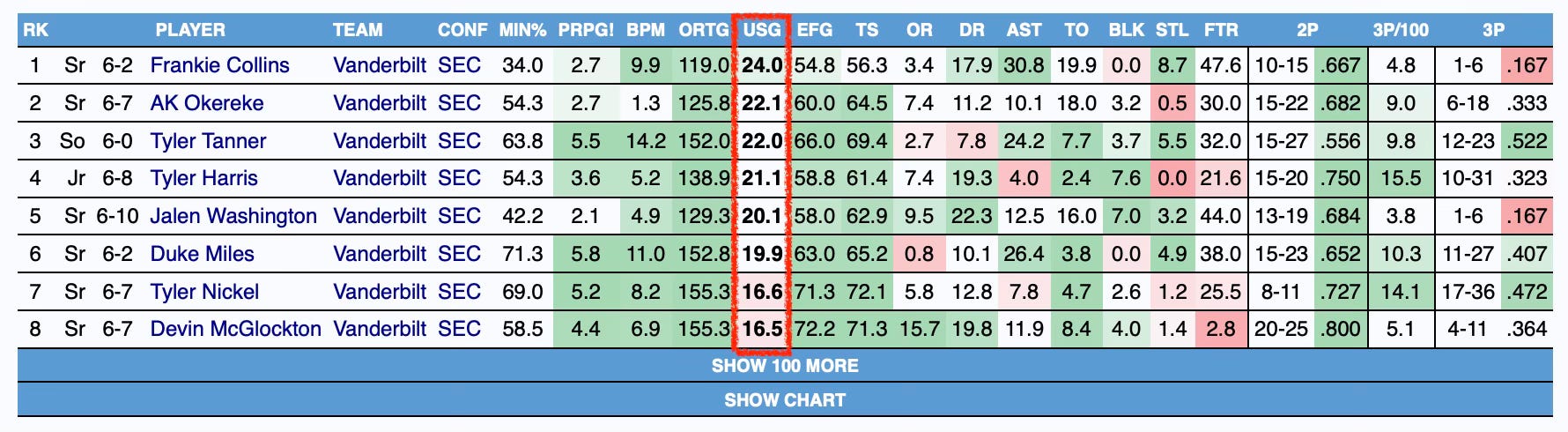
The biggest returning piece was the undersized forward Devin McGlockton, a player that enables a lot of the good stuff that Vanderbilt does on the court. During the summer the team brought in Jalen Washington from North Carolina for some additional frontcourt length, in order to provide coach Byington with additional lineup versatility, but the small ball frountcourt with McGlockton and Okereke will likely be the number 1 choice going forward.
As you probably have already realised from the title of the article, it’s McGlockton that I wanted to focus on.
Forward-center?
McGlockton is an unusual player in a sense that his frame resembles a forward, but his production last year when Vanderbilt consistently went with small ball lineups was closer to a center, which adds a tricky element attempting to contextualize his production.
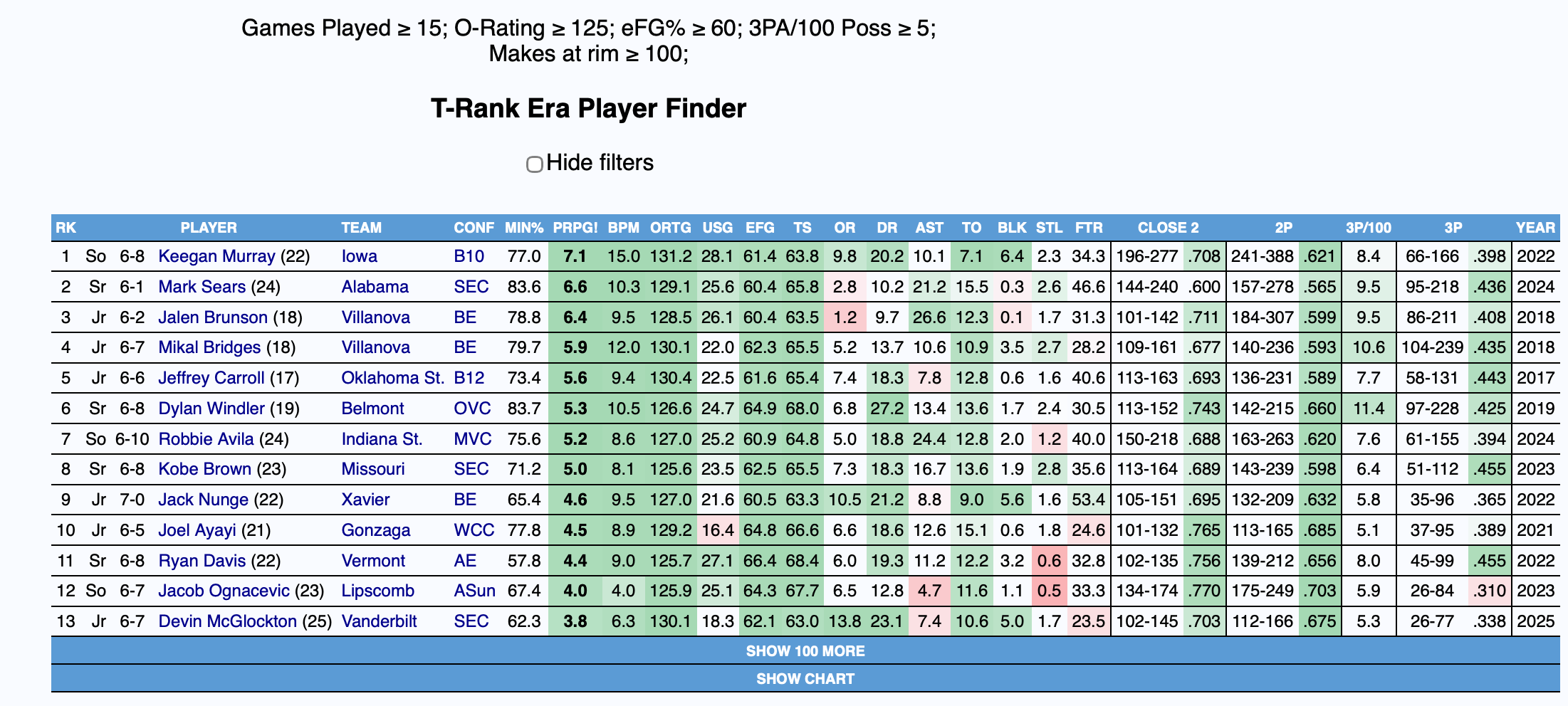
The result was that McGlockton had career-highs in DREB and BLK ates, presenting quite a unique profile for his junior year as McGlockton was the smallest player to hit this big query in all of D1.
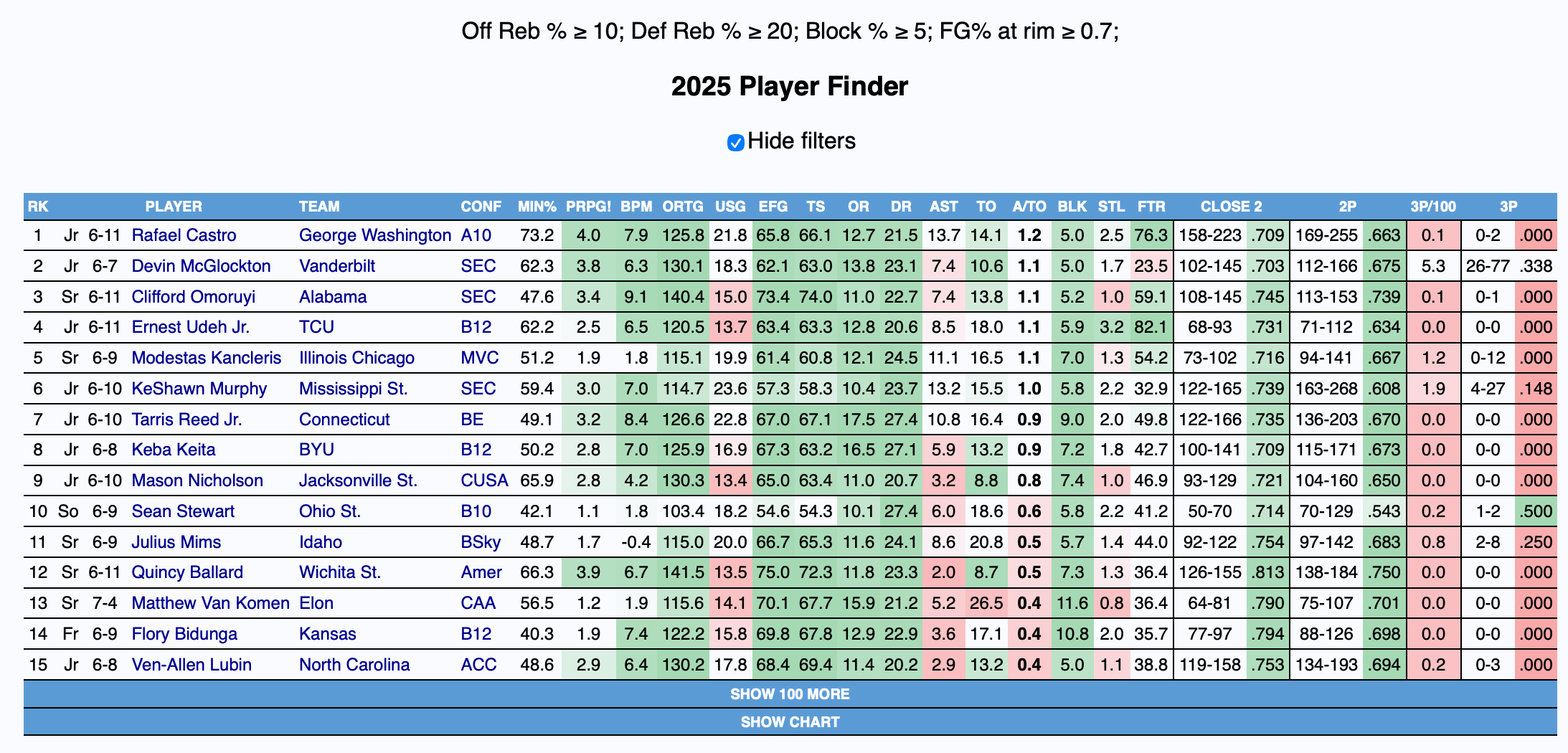
You may also notice that McGlockton is the only player in this query with any sort of 3 point volume, as well as a positive assist-to-turnover ratio, which is often a rare trait in play finishing college bigs that entails a high level of feel.
Most of that positive A/TO is accumulated through an ability to avoid turning the ball over, rather than assisting teammates.
And indeed, if you pair those qualities with a historical high feel big query, you do get some serviceable NBA outcomes, even outside of the unrealistic ones, like Anthony Davis.
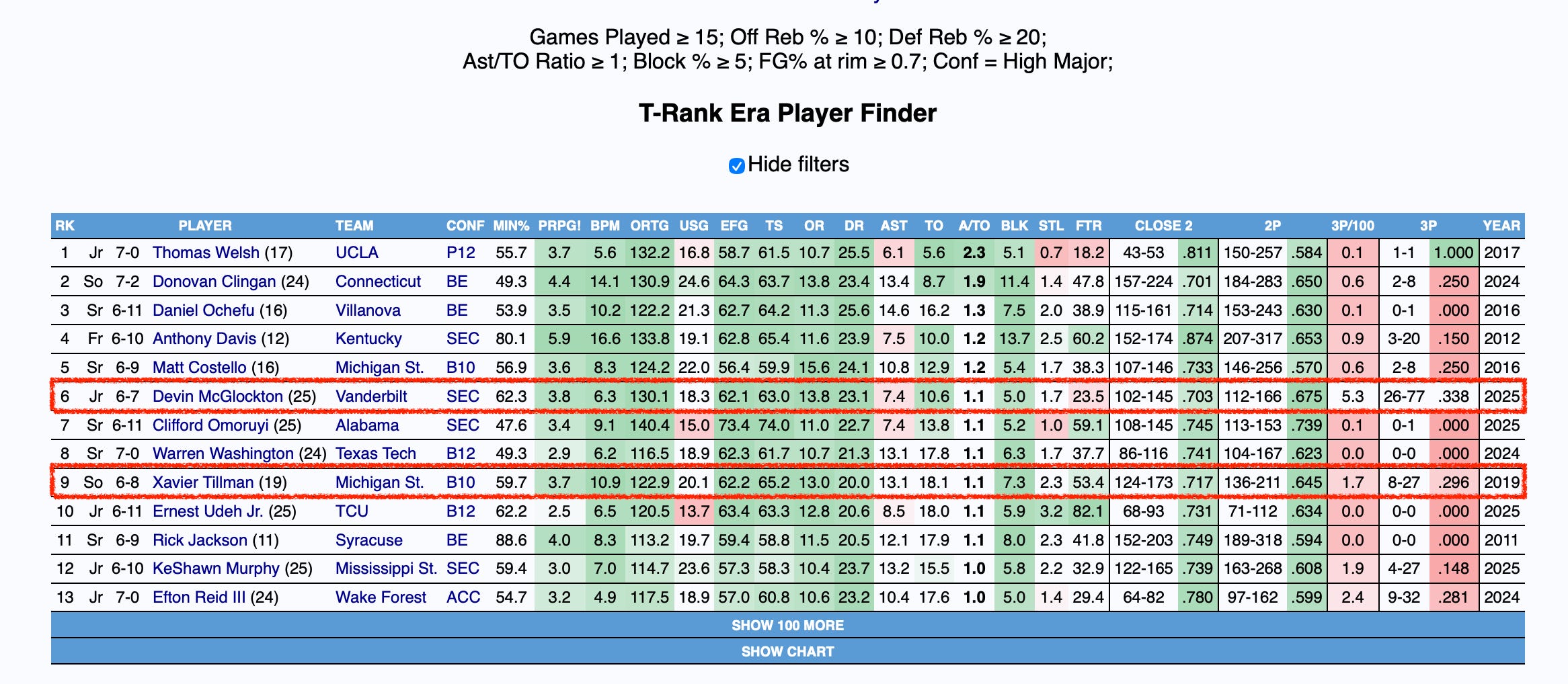
Out of these, sophomore Xavier Tillman does feel like the closest NBA comp for McGlockton, with a couple of notable differences being that Tillman was a slightly better shotblocker and got to the line at a higher rate, while McGlockton turns it over less and shoots better from three (junior Tillman technically missed out on this query because of a 9.9% OREB rate).
Tillman, a 2nd round pick in 2020, was carving himself a nice NBA career as a rotational player before persistent knee injuries stunted his development.
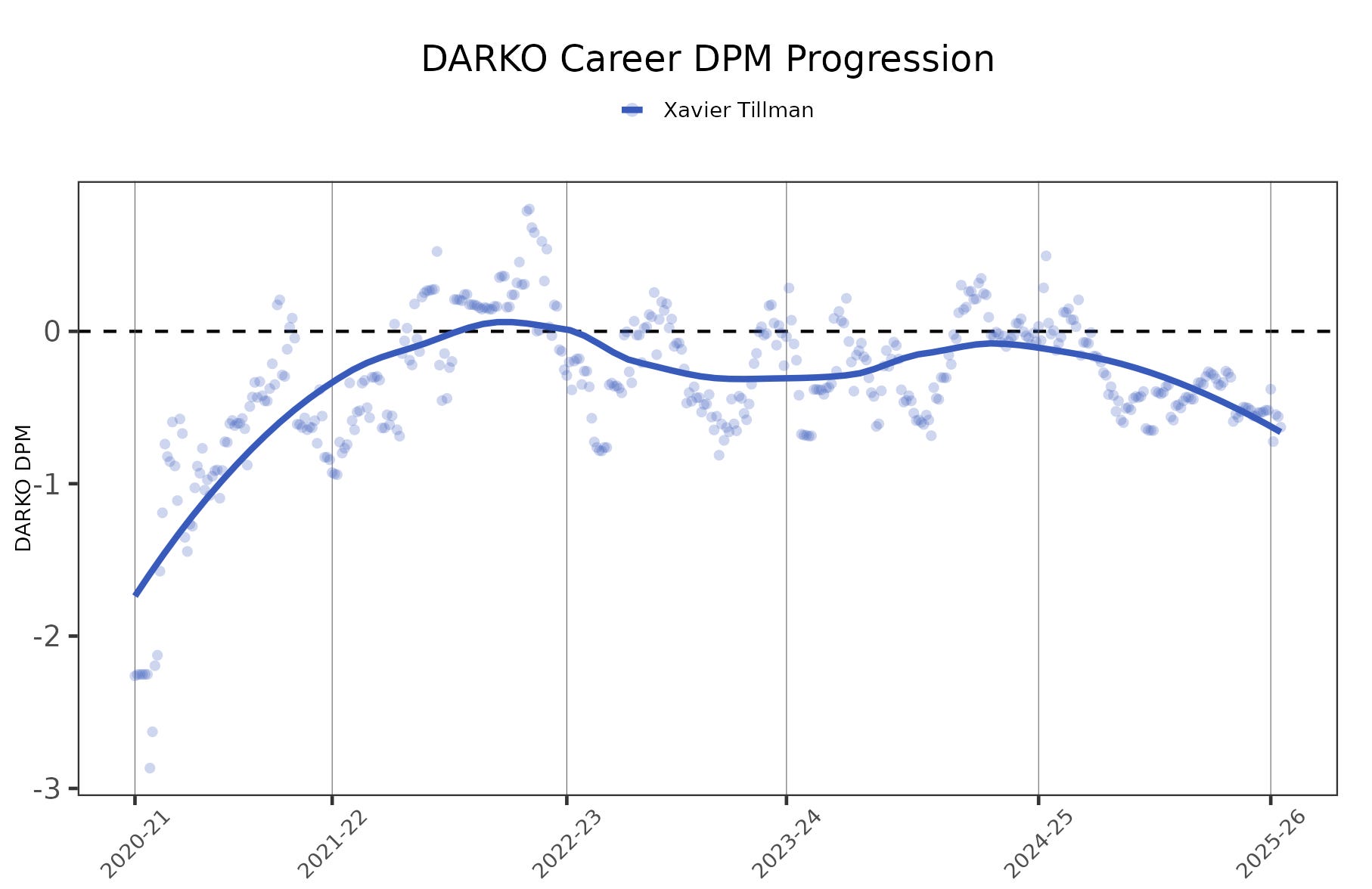
Curiously enough, on the other side of the spectrum another close comp for McGlockton is another Michigan State alumn Matt Costello, who has a grand total of four NBA games to his name and has been playing pro ball in Spain for the last six years.
Compared to McGlockton, Costello was a really strong play finisher under the basket, but had a suboptimal shot diet that leaned on long twos instead of threes, thus pushing his overall TS% below 60%.
Meanwhile McGlockton’s shot diet mainly consists of paint touches and threes, heavily prioritising high value shots. This is evident via a +5.7% effective field goal percentage in favour of McGlockton. In total last season, McGlockton took a combined of 9 shots from three and rim per 40 minutes, good for 78th percentile in D1.
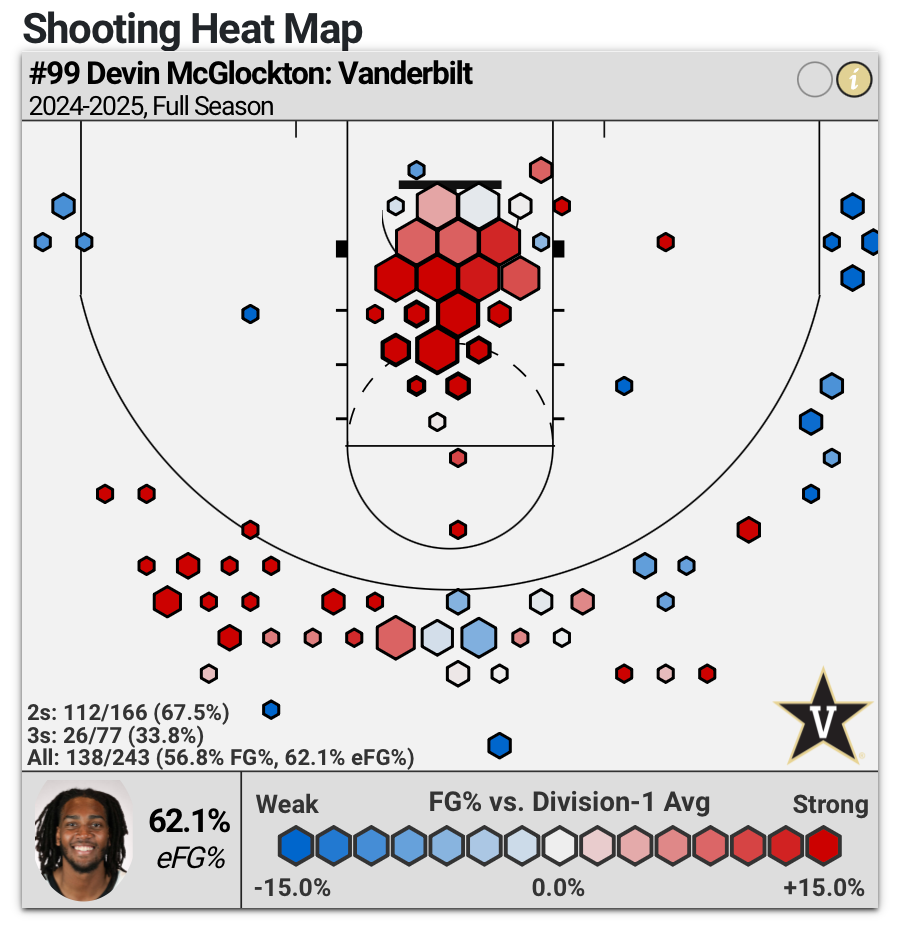
Therefore McGlockton’s junior season shot diet, efficiency and overall offensive output in his junior year offers hope of him stepping outside of the ‘undersized big’ conversations.
Ceiling raiser?
Whatever the truth is, positional translation will end up being the biggest question mark trying projecting McGlockton’s potential transition to the NBA, largely because of how he’s being used at Vanderbilt.
His stocks (Hakeem %) are firmly in the ‘not great, not terrible’ territory for a big. McGlockton also tends to foul a lot (4.8 fouls per 40 minutes), contributing to just 64th percentile personal foul efficiency (measuring personal fouls against stocks created).
McGlockton’s anthros (around 6’7” height and 7’0” wingspan) are closer to a forward than a center, but throughout his 3 year college career, the Georgia basketball product has demonstrated tremendous malleability and has essentially performed in every role role or situation he was thrusted into.
He spent his first two years in the ACC at Boston College. In his sophomore year, McGlockton was paired alongside Quinten Post. That BC team finished the ACC play 8-12 and missed the NCAA tournament, but it wasn’t because of the McGlockton-Post duo which excelled at a lot of things outside of getting to the line and offensive rebounding, largely due to Post’s average ability to crash the offensive glass (7.5% OREB at the C position, compared to 10.5% OREB McGlockton logged as a forward).

In his second year at BC, McGlockton contributed a +20.6 net rating swing when he was on the floor.
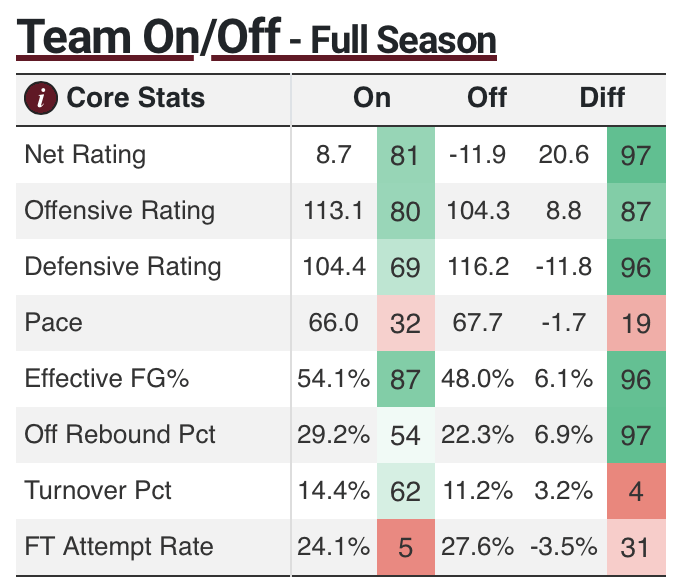
Having transferred to Vanderbilt for his junior year, it was more of the same for McGlockton as he made a +30.1 (99th percentile) net rating contribution when he was on the floor last season, though this time round he didn’t have the company of a 7 footer in the paint.
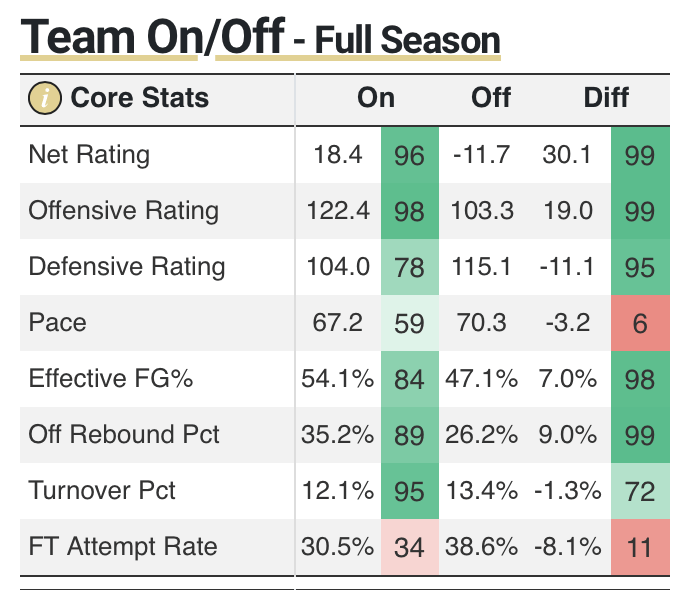
Vanderbilt played small-ball baskeball for the entirety of the season and McGlockton helped anchor those undersized lineups.
As a result, he saw a huge spike in DREB rate (13.9% -> 23.1%). BLK% jumped to 5%, which isn’t good enough for a team’s leading shotblocker, but very solid for a forward playing alongside a more traditional big.
McGlockton’s shooting is his most interesting long term skill. Last season at Vanderbilt, he wasn’t tasked with a ton of shooting; high 3 point shooting volumes were a privilege largely reserved for Tyler Nickel and Jason Edwards.
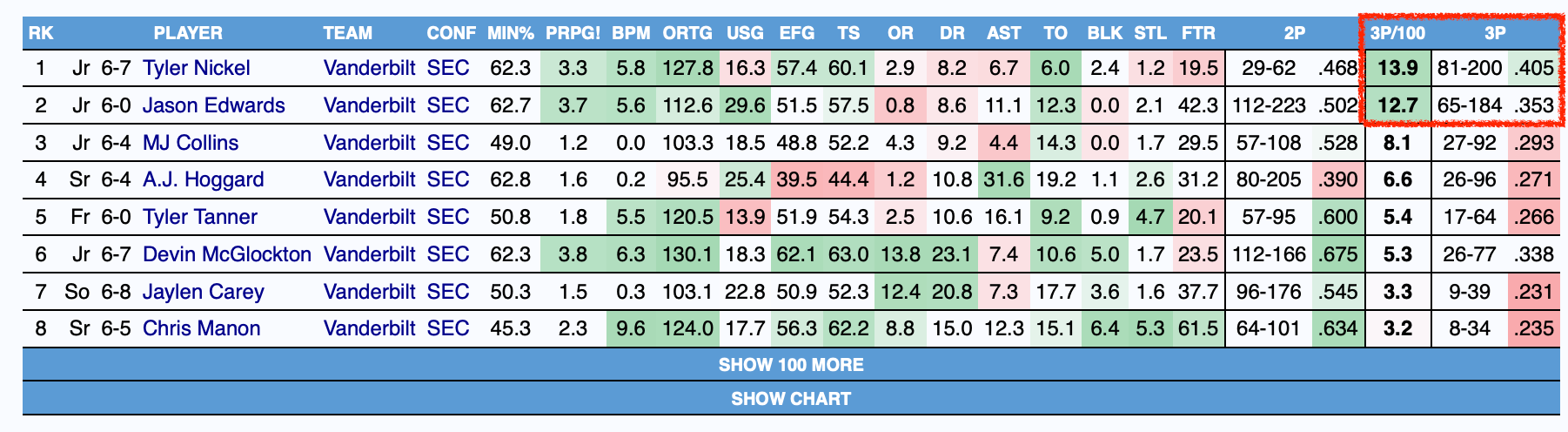
Guards like AJ Hoggard, who, like I mentioned, ended up being a destructive force on the team and who does feel like an addition by subtraction in 2025-26, also shot a higher volume, well, because they’re guards and Vanderbilt ran a high Moreyball rate, so they had to shoot.
This, to an extent, pressed down McGlockton’s 3 point rates as he was tasked with doing a lot of heavy lifting in the paint as a roller, cutter and post-up threat. He was their 3rd best shooter at 34% in 2024-25, though considering virtually all of his long ball diet was catch and shoot threes, it’s unlikely McGlockton has tons of additional 3 point volume to tap into.
The development over his first three college seasons has been somewhat encouraging: having barely shot any threes in his freshman year, McGlockton took a jump to 3.3 threes per 100 posessions sophomore season and 5.3 in 2024-25, all while maintaining solid, if not spectacular percentages.
Needless to say that a consistent 3 point shot would open up a lot of opportunities for McGlockton. On a small sample size, McGlockton demonstrated flashes as a straight line driver attacking off the dribble. He has a quick drop of the shoulder and a deceptively quick burst to get himself to the rim.
It’s also super encouraging that McGlockton has proven himself to be effectice offensively without commanding a lot of time on the ball.
Last season, per Synergy, McGlockton was a 95th percentile frequency roller and 89th percentile in efficiency scoring off the roll. He turned it over just 2.4% of the time in roll situations, implying solid ability to catch the ball and go up for layups or dunks.
He was also 85th percentile scoring off the cuts. While cutting to the basket he did tend to turn it over a bit more (8.5%), though, like I mentioned before, McGlockton’s overall offensive picture still paints a highly turnover adverse player.
In total, McGlockton shot above 70% at the rim, despite being a low frequency dunker (102 rim makes to 17 dunks).
Though he doesn’t dunk a lot, McGlockton is sneakily athletic and strong, which made him a 94th percentile layup finisher last season.
He’s got a pretty quick second jump and just knows how to use his body very well to go up for layups, as well as flashing some ability to make shots when the angle isn’t there.