
Caleb Wilson Scouting Report
Wilson may be in a tier of his own in the 2026 NBA Draft, but he's a clear top four pick


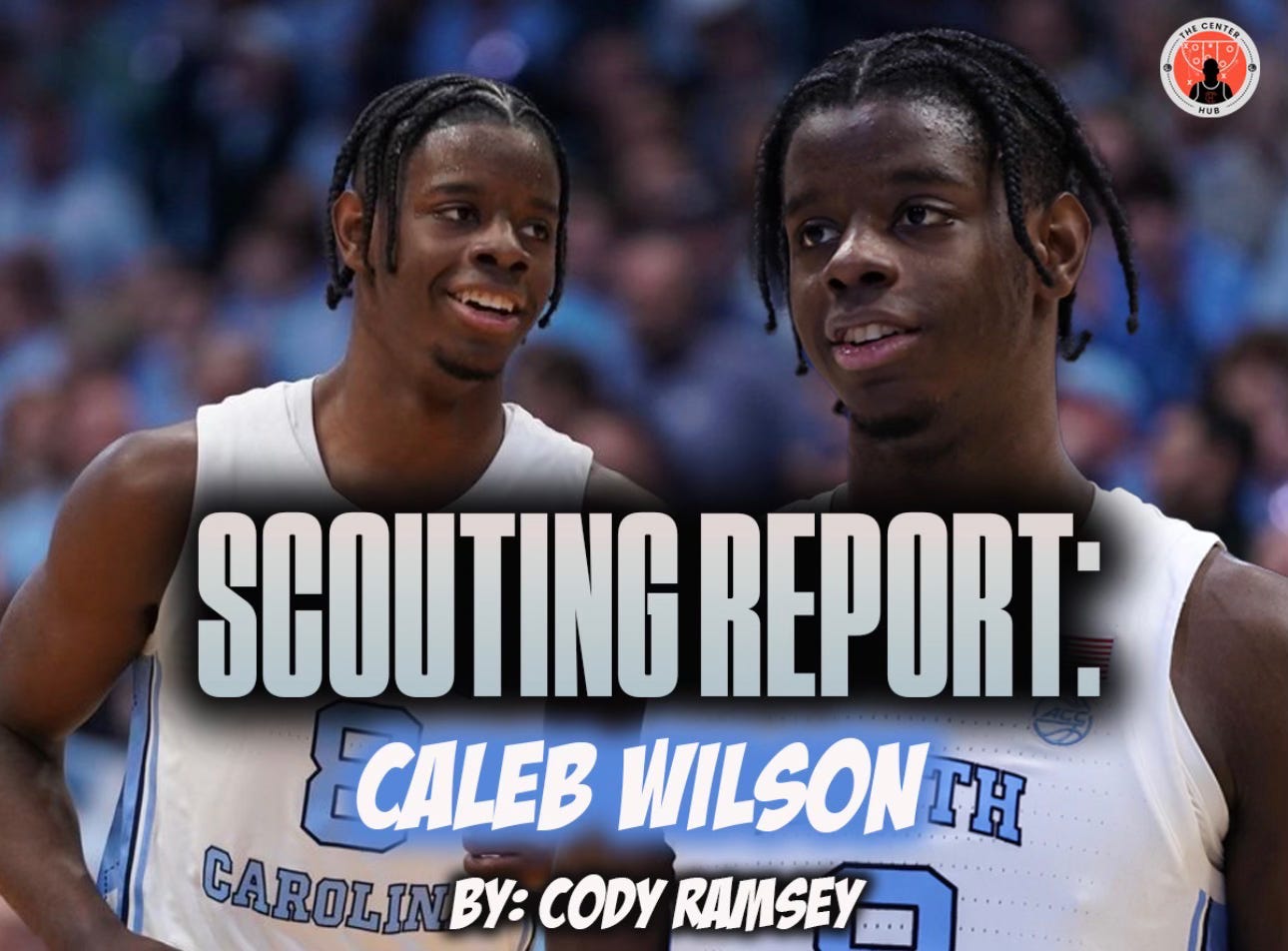
Outside of the top three players in this class, Caleb Wilson might have the most return on value in the redraft scenario as he is one of the more fascinating evaluations in this class because his strengths and weaknesses are often tied directly to the context in which he was asked to play. At North Carolina, Wilson operated as a high-usage offensive focal point, carrying a significant creation burden despite being a freshman. The raw production was impressive, posting 25.3 points per 40 minutes (99th percentile) on 63.7% true shooting (85th percentile) while maintaining a 28.1% usage rate (97th percentile). Those numbers alone are indicative of a player capable of generating offense at a high level, but the deeper statistical profile reveals both the appeal and the questions surrounding his projection.
Offensively, Wilson’s game begins with his ability to pressure the rim. He attempted 14.2 two-point field goals per 40 minutes (98th percentile) and converted an outstanding 61.0% of those attempts (77th percentile). Nearly 35% of his shot attempts came at the rim, where he finished at 59.4%, while another 20.7% of his attempts came in the paint. His combination of size, fluidity, and coordination allowed him to consistently generate paint touches and draw fouls, reflected by his 9.6 free throw attempts per 40 minutes (99th percentile) and 61.8% free throw rate (84th percentile). Few players in this class matched his ability to generate efficient offense through physical pressure and downhill attacking.
The primary offensive question revolves around his perimeter shooting. Wilson attempted only 1.4 three-pointers per 40 minutes, with a 9.2% three-point attempt rate (36th percentile) and converted just 25.9% from three. While his 71.3% free throw percentage provides some optimism for future shooting growth, teams will need to determine whether the lack of perimeter volume was a function of role, confidence, or genuine shooting limitations. In today’s NBA, forwards who struggle to provide floor spacing face a more difficult path to maximizing their value.
What makes Wilson particularly intriguing despite those concerns is his connective skill set. His passing flashes suggest there is more offensive upside than the traditional box score may indicate. Wilson recorded 3.4 assists per 40 minutes (94th percentile) while producing an impressive 1.36 assist-to-turnover ratio (84th percentile). His 17.4% assist rate (95th percentile) demonstrates legitimate feel as a decision-maker. He consistently made the extra pass, facilitated offense from the elbows and short roll, and showed an understanding of team-oriented basketball that should translate well into NBA offensive structures.
The advanced metrics are equally impressive. Wilson posted a 4.8 RAPM (95th percentile), 2.9 Offensive RAPM (94th percentile), 0.25 Win Shares per 40 minutes (99th percentile), and a remarkable 32.0 PER (100th percentile). While no single metric should be taken as definitive proof of NBA success, collectively they paint the picture of a player whose impact consistently translated to winning.
Defensively, Wilson may ultimately possess even more upside than he does offensively. However, evaluating his defense requires understanding the context of North Carolina’s overall team construction. The Tar Heels frequently found themselves in situations where Wilson was forced to cover for defensive breakdowns, defend in space, or operate in unfavorable isolation situations. Those possessions created some of the more concerning clips on his defensive tape and occasionally exposed areas where he is still developing.
That context is important because the underlying defensive indicators remain extremely strong. Wilson recorded 1.9 steals per 40 minutes (95th percentile), 1.8 blocks per 40 minutes (77th percentile), 3.7 Defensive RAPM (98th percentile), and 8.4 defensive rebounds per 40 minutes (95th percentile). He consistently generated events on the defensive end while displaying the mobility and versatility teams covet in modern forwards. At 6’10”, he possesses the length to disrupt passing lanes, the athleticism to switch onto smaller players, and the instincts to function as a secondary rim protector.
The question defensively is less about his tools and more about refinement. Wilson occasionally relied on athleticism rather than positioning and could be vulnerable when isolated against quicker guards. Yet those issues are common among young forwards and are often corrected through repetition and experience. The physical profile, effort level, and statistical production suggest a player capable of becoming a highly impactful multi-positional defender in the right developmental environment.
Wilson projects as a modern forward whose value stems from versatility. He can score efficiently around the basket, create foul pressure, facilitate offense, rebound at a high level, and provide defensive playmaking across multiple positions. The swing skill remains the jumper. If the three-point shot develops into even a league-average weapon, Wilson’s ceiling rises dramatically because it unlocks the rest of his offensive package. Even if the shooting never fully materializes, his combination of rim pressure, passing feel, rebounding, and defensive upside provides a pathway to becoming a highly valuable NBA rotation player.
Among the freshmen in this class, few prospects possess Wilson’s blend of production, physical tools, advanced metrics, and long-term developmental upside. The statistical profile suggests a player who consistently impacted winning despite operating in a challenging role, making him one of the more intriguing bets in the 2026 draft class.
 | A guest post by
|