
#12 Will Riley

6'9 | Forward | Illinois | 02/08/2006
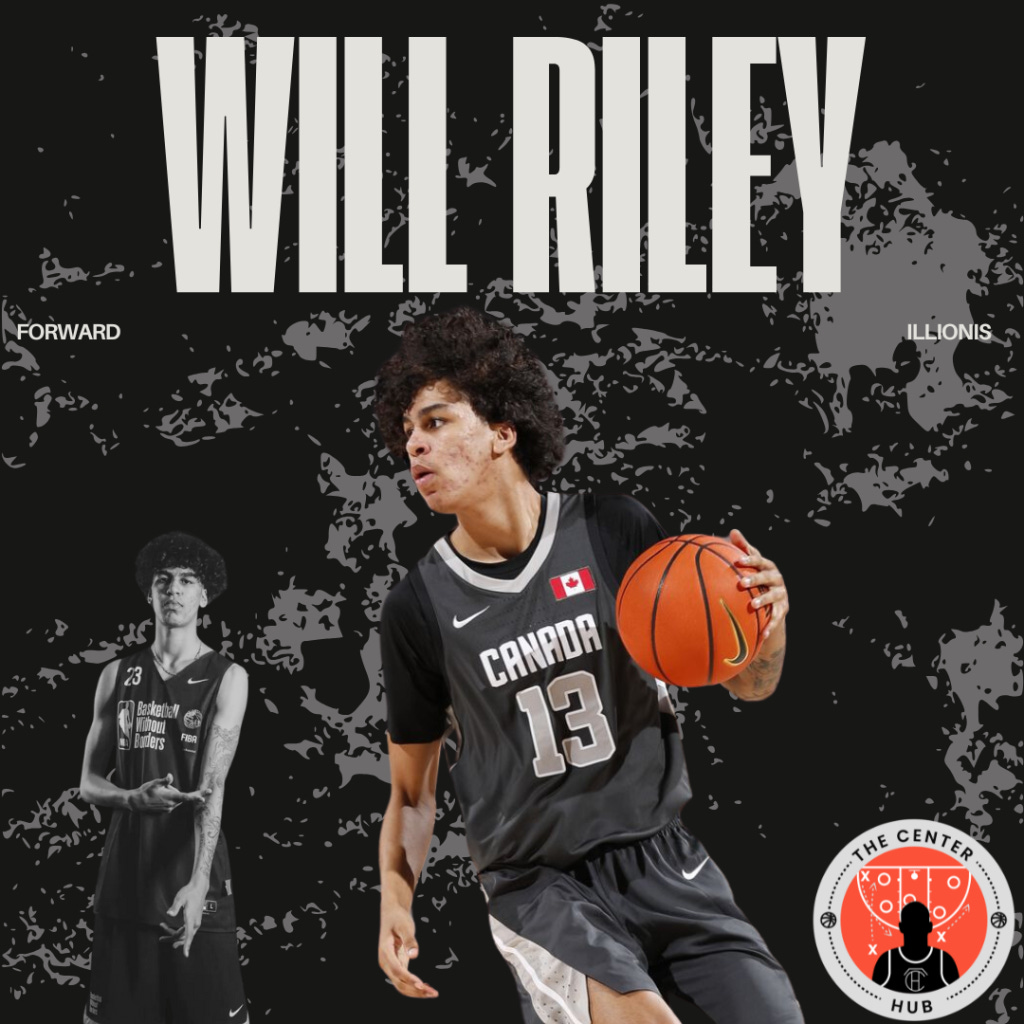

Cerebro Player Profile: Will Riley
Big Board Rankings 1.0 (@ twitter ):

Evaluation by: @codyramseygamebreaknow
12/16/24 Will Riley has far exceeded the expectations I set for him coming into the season. When projecting Riley’s role in the Illinois offense, I did not expect such a quick adaptation or high usage right from the start. Initially, I projected him as a two-year player due to the depth of Illinois’ guard and slashing forward positions. However, Riley’s early performance has proven that he is ready to contribute at a high level much sooner than anticipated.
Currently, Riley’s usage percentage is around 24%, which is very promising as it indicates he is a critical part of the offensive system at Illinois. There is no doubt that Riley is an offensive powerhouse, demonstrating the ability to score efficiently from all three levels. He is averaging 13.9 points per game on shooting splits of 45.7% from the field, 40.9% from beyond the arc, and 65.7% from the free-throw line. These numbers highlight his well-rounded offensive game and his ability to convert in a variety of situations.
Riley’s primary offensive role has been as an off-ball threat, particularly in spot-up situations. He ranks in the 86th percentile for spot-up possessions, shooting an impressive 40% from the field in these scenarios. His efficient scoring is not limited to just spot-up shooting, though. An intriguing aspect of his game is his secondary role as a pick-and-roll ball handler, which accounts for 23.7% of his possessions. In this role, he ranks in the 61st percentile and has posted a turnover percentage of just 11.1%. While being a primary ball handler is not projected to be his main role at the next level, if Riley continues to refine his skills in this area, he could project as a 6’8” secondary ball handler, which would make him even more valuable given his advanced off-ball skills.
Riley is also showcasing impressive playmaking abilities with an assist-to-turnover ratio of 2.5, although his assist numbers (1.7 assists per game) are more indicative of his role as a connective passer within the offense. While he is predominantly a perimeter scorer, it’s important to note that 67.4% of his shots are jump shots. Despite this, he has shown the ability to finish effectively at the rim. Though the sample size is relatively small (just 23.9% of his total shots and 22 attempts at the rim), he is converting at an excellent 72.7% rate on these attempts.
Defensively, Riley’s impact may not be fully captured by traditional statistics, but he has been a strong presence on that end of the floor. While defensive metrics often reflect team defense more than individual success, Riley ranks in the 87th percentile in overall defensive performance, holding his opponents to just 29.7% shooting from the floor. His success as a pick-and-roll defender is particularly notable—he has been tasked with guarding pick-and-roll ball handlers 34% of the time this season, and he ranks in the 86th percentile when defending these situations, allowing just 13 field goal attempts against him. This has been a surprising and exciting aspect of his game, as his defensive role was initially expected to focus more on guarding wing players.
Riley’s length and ability to disrupt passing lanes have been key factors in his defensive success, and while his "stocks" (steals and blocks) are not eye-popping (he has accumulated 5 stocks in 9 games), his defensive efficiency and ability to fit into a team defensive system are highly promising. Additionally, it’s worth noting that Riley has significantly reduced his foul rate from his high school days, down from 1.7 personal fouls per game to just 1.0 personal fouls per game this season, showing his improved discipline on that end of the floor.
Overall, Riley’s projected outlook as a prospect is very optimistic. If he continues his impressive offensive output, it will be hard to keep him out of the lottery. He offers excellent positional size, especially if he continues developing as a secondary ball handler, and his eclectic offensive game still has room to grow. Furthermore, his defensive output, while not elite, is certainly net-neutral and he is not a liability on that end. With continued development, Riley has the potential to become a highly valuable NBA prospect.
10/4/24 Will Riley burst onto the scene following his standout performance at the Peach Jam in 2023, propelling his stock and earning national recognition as a 5-star prospect coming out of high school. Now, as he joins a talented Illinois squad with significant depth at the wing position, expectations are high for his contributions. Offensively, Riley is an electric scoring threat, capable of filling the stat sheet quickly. Standing at 6'8", he offers impressive positional size for a guard, making him a potential matchup nightmare for defenders.
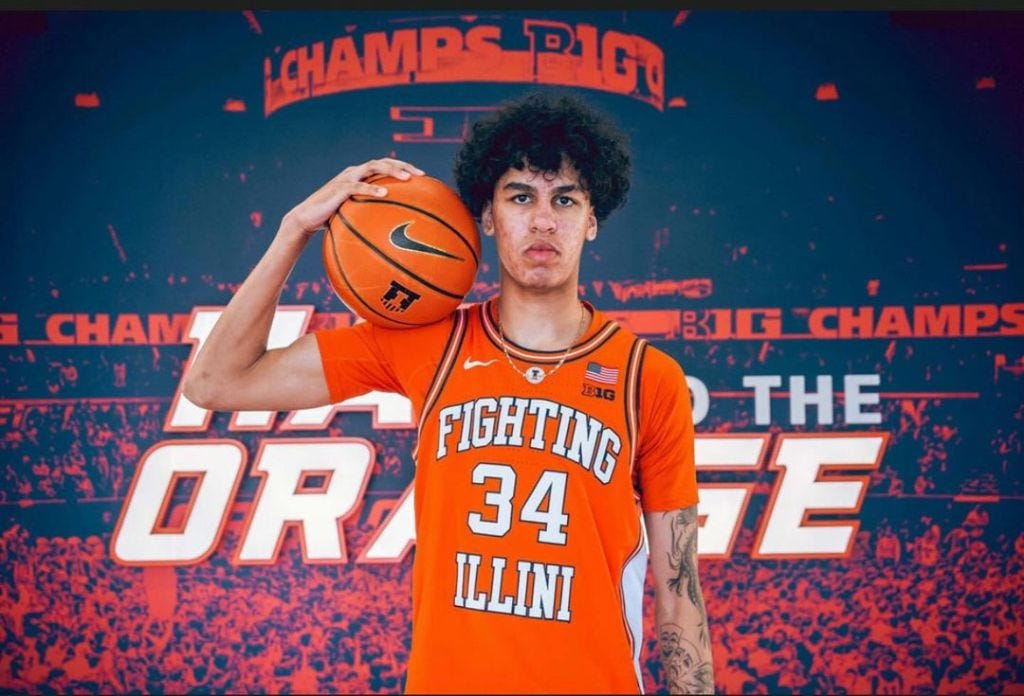
Moving forward, it’s crucial for Riley to continue developing his guard skills, particularly in playmaking and navigating tight spaces off the dribble. His lanky, wiry frame allows him to be especially effective against smaller defenders, while he has the versatility to exploit larger defenders on the perimeter. With a solid handle, he can create separation for a pull-up jumper or drive past defenders to finish at the rim. Riley is a tough shot-maker from all three levels, demonstrating excellent footwork both on catch-and-shoot jumpers and when attacking the lane. His versatility extends beyond scoring—he has experience as a play initiator, both on and off the ball, suggesting he has the potential to develop into a jumbo playmaker who can create mismatches.
During his final eight high school games, Riley averaged an impressive 22.8 points per game on 38.7% shooting from the field with a usage rate of 32.4%. However, these figures raise some concerns as he transitions to college basketball. Specifically, there are questions about how his production might adjust with a reduced usage rate and whether he can enhance his shooting efficiency by adopting a more selective shot diet. While skepticism is warranted when projecting his future performance, it’s important to consider the context of his situation. Riley likely faced intense defensive focus as the primary offensive option for his team, tasked with generating scoring opportunities. As he steps into a new role at Illinois, he will need to refine his playmaking abilities, particularly in terms of ball security. In his final eight high school games, he averaged 2.3 assists against 3.2 turnovers, resulting in an assist-to-turnover ratio of just 0.71, which will need improvement at the collegiate level.
Defensively, Riley does not stand out as an elite defender, but his positional size allows him to be utilized effectively in a system that capitalizes on his offensive strengths. While he may not provide exceptional defensive output, he can contribute without significantly compromising the team’s overall defense. It’s worth noting that he has a tendency to gamble by reaching in when opponents get by him, which can lead to unnecessary fouls. He averaged 1.7 personal fouls per game during his final eight high school contests—an area that coaches will want to monitor as he adjusts to the collegiate game.
As Riley embarks on his collegiate career at Illinois, he brings a unique blend of size and scoring ability that could make him a valuable asset to the team. However, his development will hinge on improving his efficiency, decision-making, and defensive skills. One potential drawback to Illinois’s depth is the challenge of defining his role within the system. With the right coaching and mentorship, Riley has the potential to become a significant contributor to the Illinois program and a future standout at the next level.